
The last year has seen profound shifts and uncertainty in international development – rising armed conflict, attacks on human rights and civil society, and the disassembling of foreign aid systems. These challenges have brought tremendous hardship, but they also present an opportunity: to reimagine the future of global development and recommit to the values that define philanthropy at its best. Values like dignity, equality, and the love of humanity.
At the 2025 Innovations in International Philanthropy Symposium, co-hosted with the Network of Engaged International Donors (NEID Global), the 250 funders, investors, and leaders we gathered together recognized the urgency of this moment. Innovation in philanthropy today isn’t just about new tools or structures – it’s about deepening our commitment to connection, collaboration, trust, and action. It’s about embracing and acting upon our shared humanity.
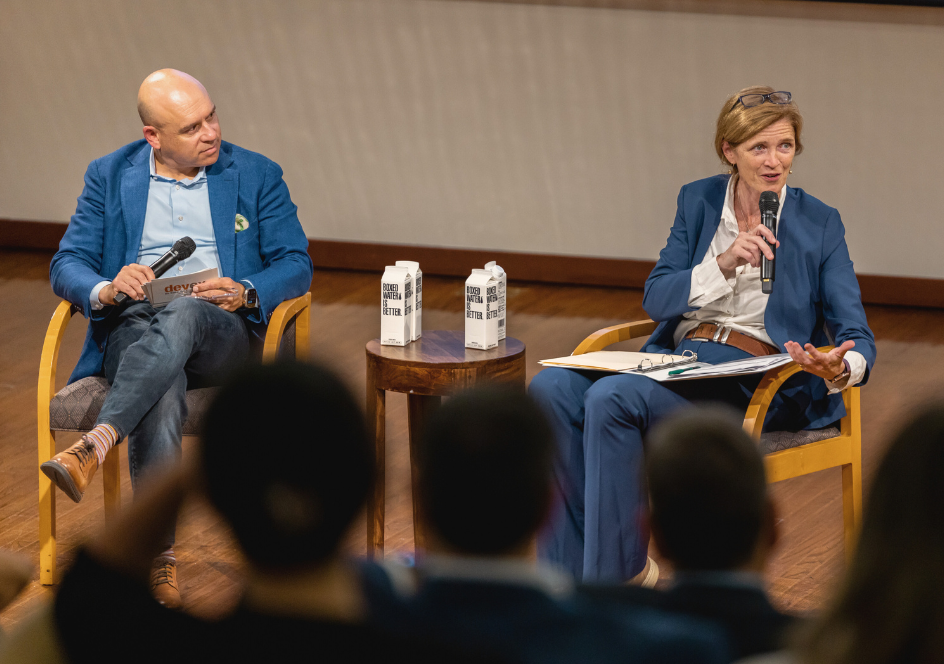
The Symposium’s opening and closing keynotes captured this spirit, bookending the learning and networking at the event with lessons on how to confront the complexity of today’s global challenges. The first, a conversation between Ambassador Samantha Power, former USAID Administrator, and Raj Kumar, President and Editor-in-Chief of Devex, focused on how to approach any broad undertaking we set for ourselves.
Power began with a striking reminder: “This is not a test; this is an opportunity.” Despite political polarization, funding cuts, and institutional fragility, she urged us not to conflate internal challenges with the suffering unfolding globally. Instead, she called on us to harness our resilience and re-commit to bold, values-driven action.
She shared five powerful ideas drawn from her time at USAID on how to embrace our agency as philanthropic leaders.
- Clarify Your Focus: With need outpacing capacity, donors must ask: What do we care about most? Philanthropy has the flexibility to prioritize organically. The most engaged donors are those who align their giving with deeply held values.
- Practice Development Diplomacy: Philanthropy can amplify impact by co-investing and collaborating across sectors. Whether tapping diaspora networks or advocating for policy change, funders can design partnerships that extend beyond programmatic support.
- Bridge Political Divides: Power encouraged openness to all contributions in philanthropy, noting that generosity and safety nets are shared values. Quoting a recent Wall Street Journal op-ed by Jim Nicholson of the Daniels Fund board and a former U.S. Secretary of Veterans’ Affairs, she pointed out that “America’s greatest safety net isn’t the government, it’s generosity.”
- Communicate with Purpose: Communications must be central, not an afterthought. In an era of caricatured narratives and misinformation, telling the story of impact is essential for nonprofits and the funders who partner with them: “Communications being hard doesn’t mean it isn’t mission critical.”
- Embrace Incremental Progress: Quoting President Obama, Power reminded us, “Better is good.” Even small, concentrated efforts can make a real difference.
Then, as summarized so beautifully in our closing keynote, “People expect government belonging, shared purpose, and the ability to act together to shape their future.” From here we find our shared common denominator as philanthropists, the reminder that we are one entity that ultimately rises or falls together. The final conversation among Heba Aly, Director of Article 109, formerly the UN Charter Reform Coalition; Rakesh Rajani, President of JustSystems; and Brian Kagoro, Managing Director of Programs at Open Society Foundations, outlined an essential mindset as the basis for integrating our individual efforts, enabling us to reach the future we know is possible as a shared destination. Drawing on their own experiences delivering change, our three speakers delivered five truths on how we can reconnect and build as a stronger, unified force:
- Acknowledge the lack of trust in existing systems. People are cynical about all forms of government, including democracies. Most power structures have been complicit in supporting industries and organizations that create the problems we say we want to solve. Child labor, pollution, lack of healthcare, food insecurity, and violence are fixable, therefore they are the result of choices made. We must commit to true, real solutions.
- Focus on solutions that lie in long-term plans to build societies, not projects. Our long-term plans must focus on how to deliver outcomes. We can and must operate at the intersections. We can provide risk capital to move systems, looking to get proximate through community foundations, endowments, entrepreneurs, local giving circles, and other opportunities to support communities from whom resources and power were extracted.
- Lean into a shared focus on what makes societies strong and what the people need: clean water, healthy food, education, security, and opportunities to engage in work that enables their communities to rise and prosper. People live well when systems work well.
- Engage in our shared humanity and include the people themselves. Including community members with inside knowledge of what is needed and the passion to create change is necessary for impact – after all, it is their own lives at stake. And our speakers specified that by “the people,” they did indeed mean those at the grassroots level. Strong leaders are not solo stars. They are only as good as those who believe in them and work with them.
- Finally, to maximize our potential as philanthropists, we must avoid being sidetracked by extraneous noise or the diversion of time and other resources by small projects. Addressing outcomes rather than initial wrongs or missteps, and working in ways that tackle multiple, overlapping challenges, while listening to the people affected, will lead us down the right paths. In turn, we will feel more confident and purposeful, and understand the value of broader thinking and risk. This positive cycle will not only expand but also ripple out exponentially as we combine efforts and the gaps between us are filled to continue the progress in the face of uncertainty.
The conversations also touched on the risk calculus facing philanthropic leaders today. Power emphasized the importance of collective action, even in today’s polarized media environment and with the perceived personal and institutional risks of speaking out. As to the potential power of the collective, a recent piece by Inside Philanthropy Founder and Editor David Callahan, cites “Americans in the top 20%, who collectively hold $62 trillion in assets – more than six times the wealth of America’s foundations and billionaires” as a potential juggernaut for good that needs only be launched. And as for the need to take action, as Power said, “It is much better to jump in with other people… If we all hold back, then what?… No matter how powerless you feel, you must find a way to remember your power.”
I’m inspired by the clarity of guidance and insight our keynotes provided and by the collective commitment of our community. We see this so often with our clients here at TPI. It is truly an honor to partner with them in the work they are so passionate about. Their dedication reaffirms every day that philanthropy has a unique role to play – one that demands courage, collaboration, and a willingness to act now. Let’s not wait for the perfect moment. Let’s jump in, together.
Our common humanity, strengthened by our convergence, can only magnify the light in the darkness.
—
Learn more about the Symposium on the event website. Learn more about TPI’s work with global funders here.


